Wildlife on the trail: iguanas, parrots and river birds near Manialtepec

A horse is a good place to watch animals from. You sit higher than on foot, you don't have to look down at every root, and there is no engine noise. The rides from San José Manialtepec follow a river, cross patches of tropical forest and get close to water, all places where things live. Here is what you may see, how to recognize it and why nobody can promise you any of it.
What wildlife lives around Puerto Escondido and Manialtepec?
The coast west of Puerto Escondido packs several habitats close together: the Manialtepec River, farmland and pasture, dry tropical forest, mangroves around the lagoon and the open beach. That mix is why birdwatchers come here. On a ride, the animals people tend to notice are iguanas, parrots and parakeets, and the birds that feed along the water.
These are wild animals. What you see depends on the season, the time of day, the water level and plain luck. Some afternoons are busy and others are quiet.
Iguanas: two kinds to look for
The first stretch of the sunset ride follows the river, where iguanas like to sun themselves on the rocks. Two species live in this part of Mexico:
- Green iguana. Often high in trees near water, and surprisingly hard to see among the leaves. Young ones are bright green; large adults can look grey, brown or orange. Look for the big round scale below the ear.
- Black spiny-tailed iguana. Usually darker, with rings of spiny scales around the tail. You are more likely to find it on rocks, walls, fence posts and tree trunks.
Both appear on Mexico's official list of species at risk (NOM-059), so look, photograph and leave them alone. If a branch shakes for no obvious reason or something splashes into the river, an iguana may be the explanation.
Parrots and parakeets: listen first
You will usually hear them before you see them. Two to know are the white-fronted parrot, a stocky green parrot with a white forehead and red around the eyes, and the orange-fronted parakeet, smaller and slimmer, with a long pointed tail and an orange patch above the beak.
Green birds in green leaves are nearly invisible when they sit still. Your best chance is when a noisy group takes off or passes overhead, which often happens early in the morning and again late in the afternoon.
Other voices in the trees may belong to the West Mexican chachalaca, a brown, long-tailed bird that calls in loud choruses, or the white-throated magpie-jay, blue and white with a curly crest and a very long tail.
River and lagoon birds
Where there is shallow water, there are birds working it:
- Egrets and herons. The tall white great egret, the smaller snowy egret with its yellow feet, and the compact, darker green heron waiting motionless at the edge.
- Kingfishers. The ringed kingfisher is large, with a rusty belly and a rattling call. The green kingfisher is much smaller and flies low over the water.
- Black-necked stilts. Black above, white below, on very long pink legs. The Cornell Lab's identification page shows what to look for.
When you reach the coast, look up. Brown pelicans glide in lines over the waves, and magnificent frigatebirds hang on the wind with long, angled wings and forked tails. Inland, vultures circle over the fields.
What about crocodiles?
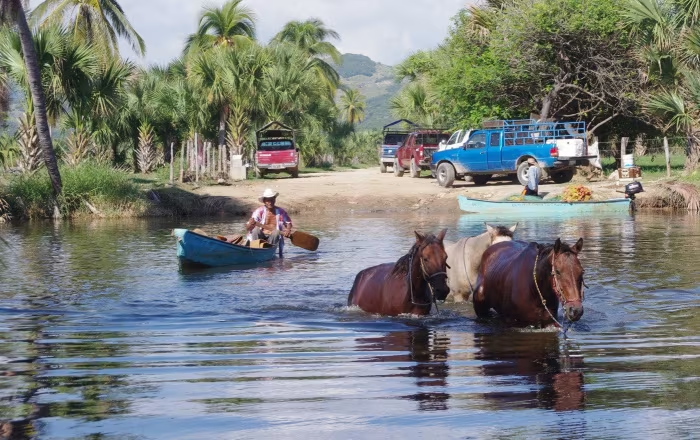
American crocodiles live in the Manialtepec lagoon system. On the private ride, the route reaches a branch of the lagoon where the horses swim across while you go by boat, and small crocodiles often bask among the mangroves. Your guide will point them out if they're around. The sunset ride and the private ride follow different routes, so check which one you are booking. Our post on the lagoon crossing explains how it works.
When is the best time to see animals?
Birds tend to be most active in the first and last hours of daylight, while iguanas like the warmth of a sunny day. From roughly October to April, migrants from North America join the resident birds, so the drier months are a good time to look. The rainy season brings full rivers and thick leaves: lush to ride through, but harder to see into.
The sunset ride picks you up at 3:00 PM and sets off on the trail around 4:00 PM. The morning ride to the Atotonilco hot springs has an 8:00 AM pickup and heads inland up the river valley.
How to spot more from the saddle
- Keep your voice low on the river and forest sections.
- Watch your guide. If they stop and point, follow the line of their arm before reaching for your phone. Ask what the animal is called locally.
- Look at the edges: riverbanks, bare branches, fence posts and the tops of dead trees.
- Bring small binoculars on a strap if you like, and use them only when your horse is standing still.
- Don't expect close-ups. A phone zoom from a moving horse rarely does a bird justice. Our photo tips for riders help.
- Don't feed, call or chase anything, and take your litter back with you.
If you want to put names to what you saw, eBird has photos and range maps for birds. To learn where the day begins, read about San José Manialtepec, the village where the rides start.
Photo: puerto-escondido.mx